Global Parallels and Scholarly Corroboration
The South Downs assemblage is not an outlier, it is a mirror of what professional archaeology already knows, only in an older context. The same tool types, materials, and reduction systems found here are documented across hundreds of accepted sites of archaeological significance worldwide.
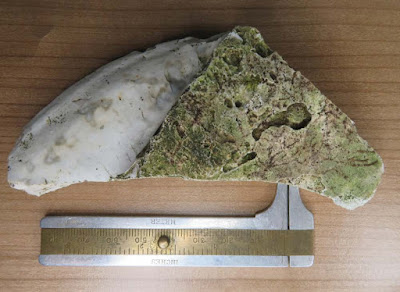
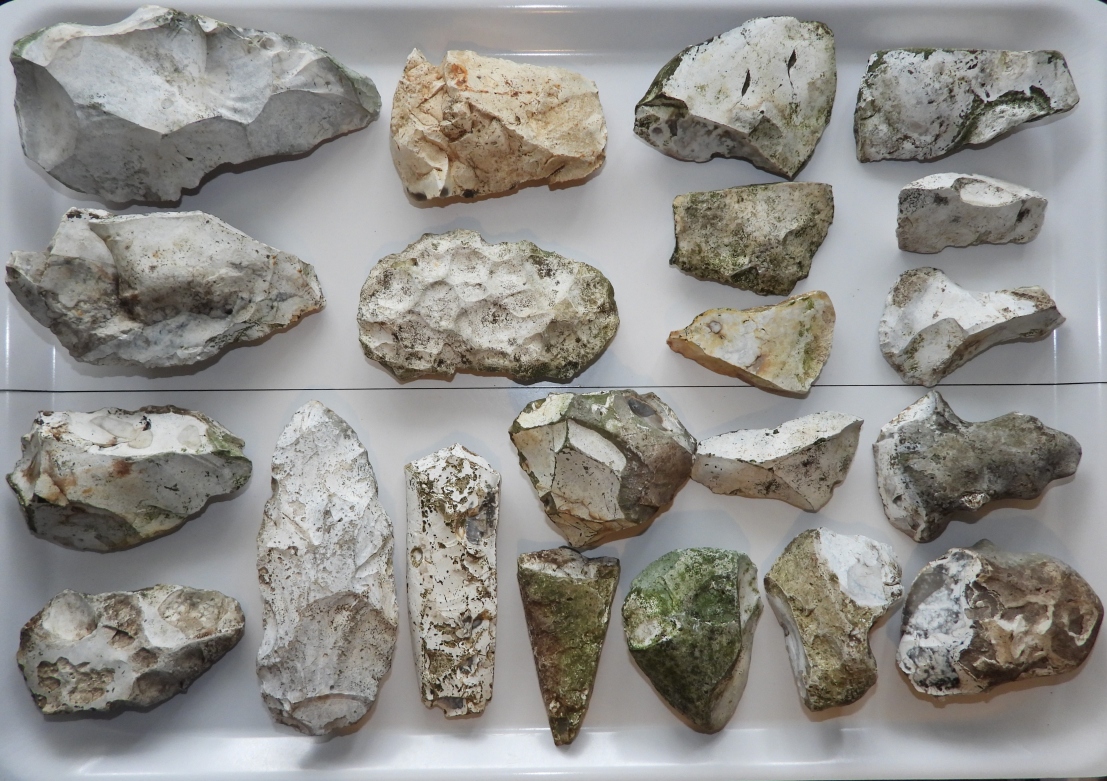
Every technological form present on my site is mirrored on the most ancient sites worldwide: the plate (tabular) flints, hammerstones, ovates, Acheulean handaxes, Oldowan style choppers, flake scrapers, and core tools. This aligns directly with the documented typologies used by field archaeologists for over a century. The tar glues and red ochre residues, often found on tool surfaces and in hafting areas, match pigment/glue use reported in both Lower and Middle Palaeolithic contexts. Even the associated echinoid fossils and rare faunal traces fit the archeological narrative perfectly, providing a natural provenance and confirming this is no random surface scatter.
What I find here on the South Downs is exactly what professionals have found and described elsewhere, the same technologies, materials, and behaviours, appearing together in clear association. The only difference is temporal expectation. My site simply pushes those patterns further back in time.
This is not contradiction, it is continuity, it is a direct link between the global archaeological record and a newly exposed British horizon. A detailed and ever expanding list of parallel studies and site citations is maintained at Paleolithics Research, which collates these professional correlations and supporting references.
FTIR Spectroscopy: Direct Proof of Artifactuality
When I speak about eoliths, figure stones, and prehistoric flint art from the South Downs, I am not offering impressions or speculation, I am presenting physical evidence.
The clearest, simplest proof that these are genuine artifacts, shaped and modified by intelligent hands, comes from FTIR spectroscopy carried out on three specimens from my assemblage.
None of these pieces would be classed as “standard tools” under orthodox typology. Yet two bear obvious figuration, recognizable motifs consistent with deliberate artistic shaping. Under FTIR analysis, all three show identical tar like organic residues, chemically distinct from the natural background, confirming purposeful human (or human like) application.
This tar appears in three distinct contexts:
- Hafting residue, adhesive used to fix a stone to a handle or shaft.
- Etched or painted application, fine lines resembling stick drawing incisions.
- Detail enhancement, targeted darkening of figurative zones such as eyes or facial details.
The spectra match ancient bituminous compounds, not modern contamination, proving intentional modification. This is direct, laboratory confirmed evidence of artifactuality from my South Downs site.
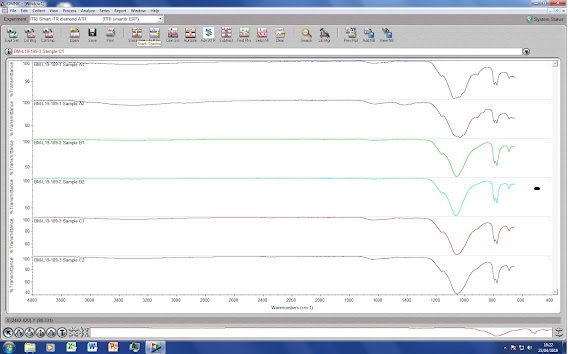
[FIG1: FTIR spectra overlay of three white flint figure stones showing identical tar absorption bands.]
Key Lines of Evidence
What follows is the logic chain I actually use on the ground at the South Downs site and across my wider collection. It is not one lucky stone and a big claim. It is a mesh of independent observations and tests: geology, patina, reduction sequences, typology and topology, evidence of cognition, and probability.
Each section ends with a link to a longer article where the subject is explored in detail.
1. Geological Context and Patina Consistency
The first question is always: where did this flint come from, and what has happened to it since it was created?
On the South Downs, many tools and figure stones occur directly within Tertiary or older chalk and gravel horizons, not modern ploughsoil. These pieces appear with fossil echinoids, tabular flint, and iron nodules in a stable, high altitude, thin soil, ancient geological setting inconsistent with Holocene disturbance.
The patina is also very consistent across the assemblage:
- Thick, uniform white or cream patina enveloping the entire surface, including flake scars and figurative regions.
- Later chips or break marks reveal fresh interior dark grey or blue flint, confirming that the outer surface formed long before recent exposure.
- Pieces from site share nearly identical patina signatures, while a few local artifact finds differ markedly.
This triple match, geology, consistent patina, and fresh versus ancient breaks, is what one expects from ancient artifacts that remained undisturbed for vast time spans, not invented natural actions, happening randomly through time, that miraculously create tool and creature shapes.
Further reading:
- World’s Oldest Stone Tools – Not Out of Africa, but Here in the U.K. on the South Downs
- Eoliths, Flint Tools and Figure Stones
2. Reduction Sequences, Flake Removal and Knapping Traits
The next test is technical: does this object behave like something knapped by human hands?
Across the assemblage are:
- Clear striking platforms, bulbs of percussion, and ripple lines.
- Sequential flake removals that thin and shape cores in logical order.
- Intentional edge retouch and regularisation.
This is standard lithic analysis, the same features taught to identify Acheulean or Mousterian tools. Rejecting them here simply because the context is “too old” is methodologically inconsistent.
Early machine debunk experiments with rotary crushers fail this test entirely. They yield chaotic fracture, not systematic flaking or reduction strategies.
Further reading:
- Eoliths in Europe: Controversy, Critique, and New Evidence
- Eoliths Are Ancient Tools – 10 Debunks of the ‘Geofact’ Claim
3. Typology and Topology: Repeating Tool Forms and Images
Two interlinked structures run through the material:
- Typology, recognisable tool categories, from Oldowan style choppers to Acheulean ovates and scrapers.
- Topology, the placement and composition of forms and motifs.
These pieces repeat the same core and flake architectures, and more intriguingly, they display consistent iconic arrangements:
- The elephant and front leg motif recurs across multiple pieces, often alongside an ape face.
- Repeated thumb and hand shape forms appear, if pointed these out in independently found handaxes also.
- Human and animal faces occupy the same relative areas, like a visual grammar.
Such repetition argues against coincidence. Nature does not produce a recurring lexicon of motifs across multiple contexts.
Further reading:
- Eoliths, Flint Tools and Figure Stones
- World’s Oldest Stone Tools – Not Out of Africa, but Here in the U.K. on the South Downs
4. Patina Thickness and the Bounded Dating Method
Patina, properly measured, acts as a bounded dating system. Using cross sections and digital microscopy, I record patina thickness in micrometres, then compare with hydration rates and geological expectations.
Fully developed patinas, tens to hundreds of micrometres thick, are consistent with multi million year exposure, not Holocene surface weathering. Assemblages show coherent patina groupings by layer, reinforcing stratigraphic stability.
Further reading:
5. Evidence of Cognition: Symmetry, Optimisation and Problem Solving
In Eoliths and Evidence of Cognition I set measurable indicators of deliberate thought:
- Symmetry and edge optimisation far beyond random fracture.
- Functional compromise, designs balancing grip, strength, and purpose.
- Repetition of figurative and geometric motifs.
Together, these reveal planning behaviour, the mental signature of intelligent design.
Further reading:
6. Portable Rock Art, Figure Stones and a Palaeolithic Visual Language
Tools and art merge here. Many flints show deliberate imagery, elephants, apes, birds, faces, executed through flake selection, pigment, or incised detail.
These repeatable motifs form a visual lexicon, functioning like symbolic language, or a silent hunting aid. Placement, orientation, and recurrence across the assemblage suggest that the South Downs people communicated visually long before writing evidence exists.
Further reading:
7. Assemblages, Probability and the “Geofact” Debate
Pareidolia fails as an explanation when structure overwhelms chance. Across hundreds of pieces:
- Sequential reduction logic persists.
- Iconography repeats predictably.
- Layers cluster distinct tool and figure sets.
Random fracture does not organise itself this way. Probability favours deliberate agency, an easy debunk, as nobody has an assemblage of car stones to display.
Further reading:
8. Eoliths in Europe and the Historical Literature
This work extends a European lineage, Bourgeois, Commont, Rutot, de Mortillet, whose early twentieth century documentation showed similar tools in Tertiary strata. Modern dismissal stems not from analysis but from discomfort with their implications. The South Downs assemblage fits seamlessly within this earlier record.
Further reading:
9. Summary: A Testable Science of Eoliths
Together, the evidence shows:
- Geology and patina confirm great antiquity.
- Reduction sequences prove intentional knapping.
- Typology and topology demonstrate repeated design logic.
- Patina metrics provide age boundaries.
- Cognitive indicators show problem solving and artistry.
- Figure stones reveal communication systems.
- Probability and cross comparison disprove random geofact hypotheses.
- European precedent validates the assemblage’s context.
These are measurable, testable datasets, not curiosities. The South Downs site shows cognition, symbolism, and toolmaking extending far deeper into prehistory than current models allow.
© Eoliths.org · Independent research project of Brett Martin.